A Short History of Gravitational Waves
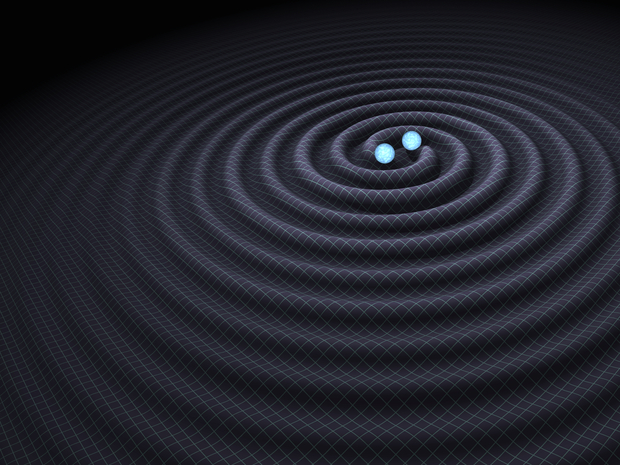
PHOTO: R. Hurt (Caltech-IPAC)
How to Read a Skymap
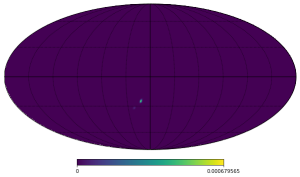
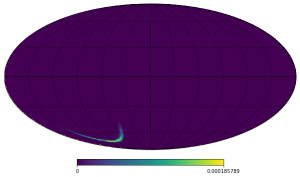
This kind of skymap is called a Mollweide map and works exactly like maps of the globe, where the spherical Earth is represented as an oval. The brightness of each pixel represents the likelihood that the gravitational wave originated from that location in the sky, the bar at the bottom shows the probability gradient and the highest probability pixel value.
GW150914
At 9:50am (UTC) on the 14th of August 2015, LIGO announced the first confident detection of a gravitational wave. The wave was created by a binary black hole merger with corresponding masses of around 37 and 31 times the mass of our sun (a quantity abbreviated to Msun). The resultant black hole has a mass of around 63 Msun, meaning about 5 Msun was released as energy in the form of gravitational waves
GW151226
The second black hole merger detected by LIGO, with black holes of masses 14 and 8 Msun. The final mass of the black hole was around 20 Msun and so about 2 Msun was released as energy.
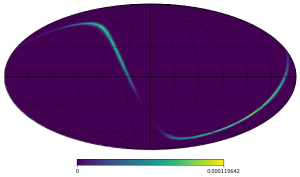
GW170814
For the first time, both LIGO and VIRGO detect the same gravitational wave. Caused by a binary black hole merger of masses around 31 and 25 Msun. The resultant black hole has a mass of around 53 Msun and about 3 Msun was released as energy
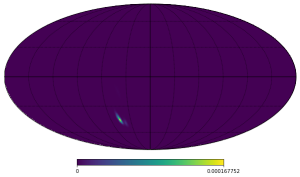
GW170817
The first instance of LIGO and VIRGO detecting gravitational waves from colliding neutron stars, with masses around 1.5 and 1.2 Msun. This was the first ever event to be detected with both gravitational waves and light.
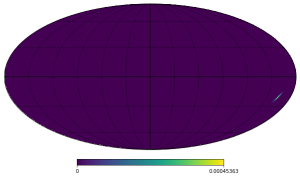
GW190814
On the 14th August 2019 LIGO and VIRGO announced their latest discovery, a binary merger between a black hole of around 23 Msun and a smaller companion of mass 2.3 Msun. However, scientists were not sure whether the companion was either the heaviest known neutron star, or the lightest black hole. This ‘mass mystery’ has still not been solved