
Header: Caltech/MIT/LIGO Lab
LIGO and VIRGO
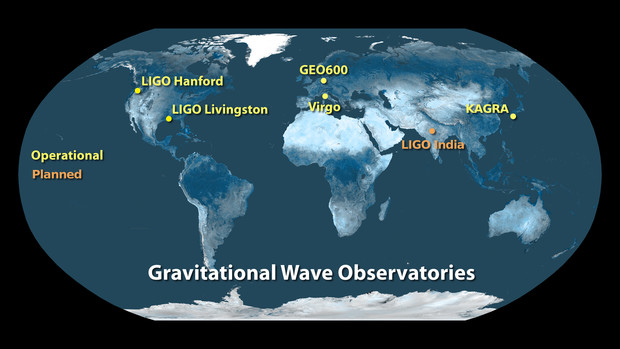
LIGO stands for the Laser Interferometer Gravitational Wave Observatory and is made of two Interferometers based in America, one in Livingston, Louisiana and the other in Hanford, Washington State. VIRGO is named after the constellation and is a single Interferometer based outside of Pisa, Italy. All three are located in areas of little human activity, so that less noise is generated.
The concept of LIGO was conceived in 1984, as a joint project between Caltech and MIT, being built between 1994 and 1999 and up to today has cost about $1.1 billion to build, improve and run. Rainer Weiss, Kip Thorne and Barry C. Barish won the 2017 Nobel Prize award for their contributions towards LIGO.
VIRGO began construction in 1996, having a yearly budget of around €10 million and first agreeing to share results and collaborate with LIGO in 2007.
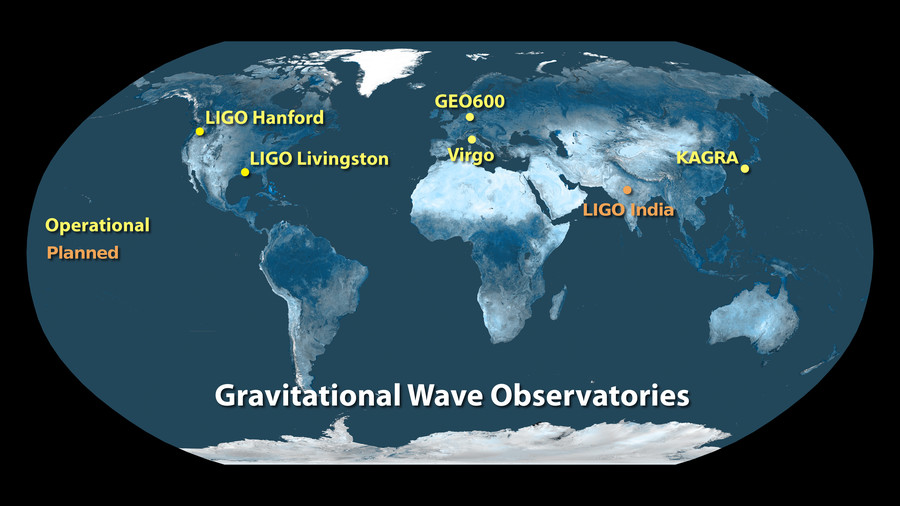
PHOTO: Caltech/MIT/LIGO Lab
How they work
Each of the Interferometers are based off the Michelson interferometer, created by Albert Abraham Michelson in the late 19th/20th century.
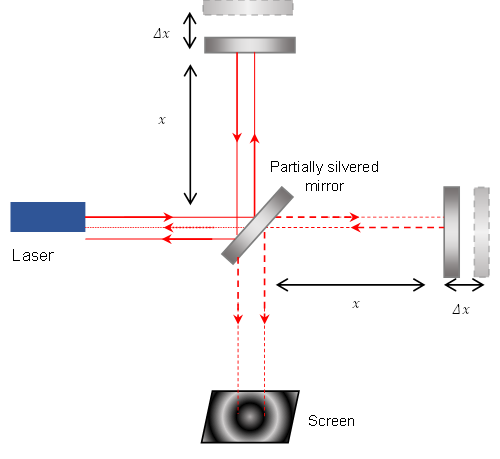
The setup comprises of a single laser beam that is split into two by a beam splitter, the beams are directed along a relatively long distance (for LIGO and VIRGO these are 4 and 3 km respectively long concrete arms) towards a highly polished mirror. The beams are reflected back at each other and interfere and the intensity of light created by this is detected by a Gravitational Wave Detection port.
In practice the laser light in each arm is reflected around 300 times before it reaches the mirror, increasing the lengths of the arms from about 4 km to 1,200 km!
Interference
Interference is a characteristic of light defined by its wave-like nature. If two waves of the same frequency, wavelength and amplitude meet they can either cancel each other out or create a larger wave. The phase difference of the waves determine which of these outcomes occur. Phase is the offset of a wave from a specific point and phase difference determines whether when two waves meet, they will match up and therefore add to create a larger wave (constructive interference) or be opposite and minus from each other, or even cancel out (destructive interference)
Gravitational waves distort spacetime, stretching one arm of an interferometer and squeezing the other. This causes a difference in phase between the two waves as one has to travel longer than the other to reach the detector, changing how the waves interfere . The changes are recorded and this makes up the data produced by LIGO and VIRGO.
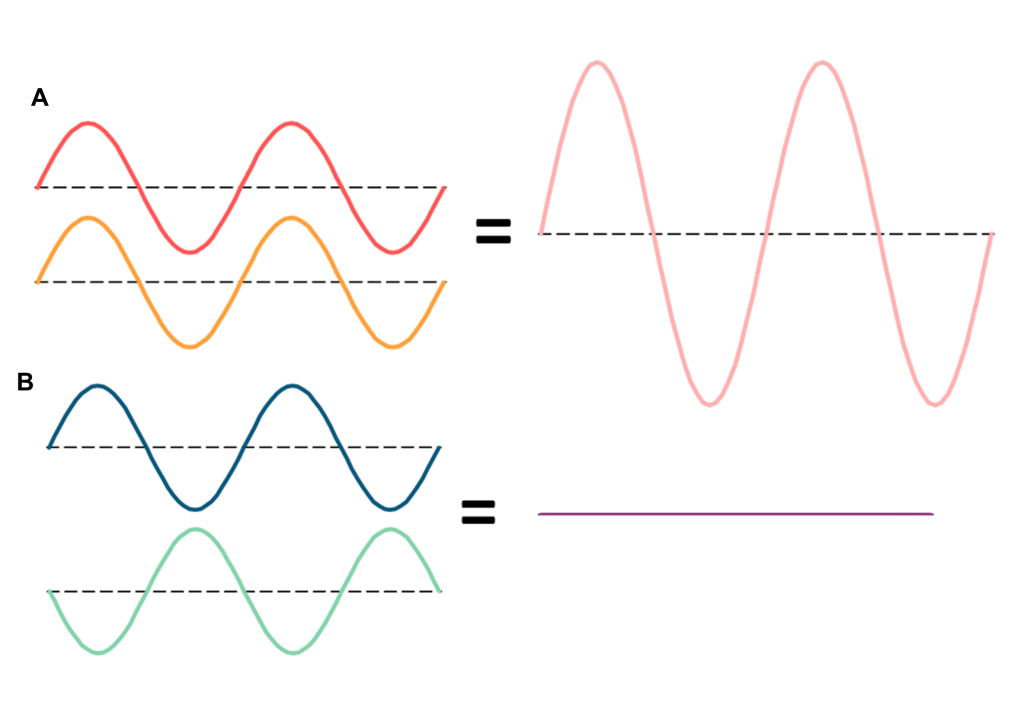
Destructive interface (B): waves are out of phase and therefore subtract from each other, cancelling out