
Header: R. Hurt (Caltech-IPAC)
Gravitational Waves
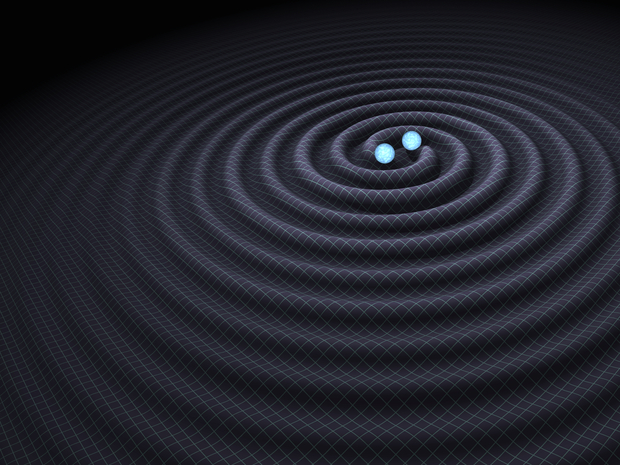
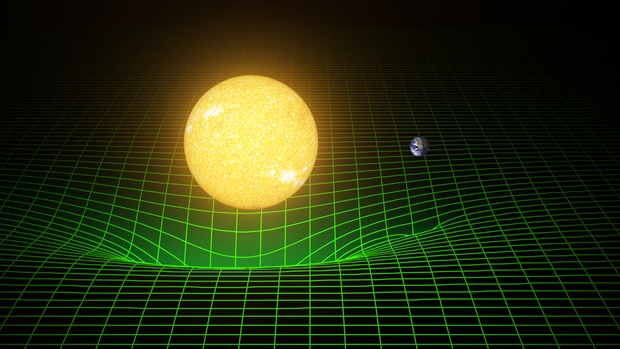
Massive bodies like the sun or Earth bend the fabric of spacetime, as the Earth orbits the sun it is constantly changing direction and therefore accelerating. This acceleration causes gravitational waves.
Gravitational waves are disturbances through spacetime, that come from accelerating bodies of mass. These waves are like ripples on a pond and spread from the source at the speed of light. They were first predicted by Einstein in his theory of general relativity in 1916.

Image: Caltech/MIT/LIGO Lab/(T. Pyle)
Why Should We Care About These Waves?
Gravitational waves are a whole new way to explore our universe, previously we were limited to looking at the universe around us just through the medium of light. Gravitational waves give us a way to look far into the past of the universe, for example, the first wave detected by LIGO was discovered on the 14th September 2015 but came from a collision of two black holes that happened over a billion years ago!
Because they don’t rely on light, gravitational waves allow us to look directly at objects that don’t emit any light, like black holes. Before gravitational wave astronomy we could only infer their characteristics from observations of material surrounding the black hole but with gravitational waves we can look right at them, learning about their masses, radii and speeds.

Image: Gerd Altmann from Pixabay
Terminology
Naming a wave
Gravitational waves are named by the date they are found, in the format GWYYMMDD. For example: the first gravitational wave found on the 14th September 2015 is named GW150914.
Observing Runs
Interferometers like LIGO and VIRGO are only online for a set period where they record data before they are shut down again. This is so maintenance and upgrades can be performed without causing excessive noise and potentially ruining data.
These observing runs are labelled numerically and currently LIGO and VIRGO have completed three of these runs O1, O2 and O3. The fourth, O4, is due to begin in May 2023 with 18 months of observing time with multiple maintenance breaks and is projected to end in 2025.